National Co+op Grocers Releases Findings in their 2025 Impact Report
Saint Paul, MN — National Co+op Grocers (NCG) has released their 2025 Food Co-op Impact Report, highlighting how community-owned grocery stores continue to thrive by supporting local farmers and suppliers, offering more organic and responsibly sourced food, and investing in the health and well-being of their communities.
“The report underscores that community owned food co-ops are succeeding by offering a different kind of model – one where shoppers own the store, farmers get more stable markets and profits stay local,” said Allie Mentzer, Chief Public Policy Officer, Advocacy & Sustainability at NCG. “NCG continues to work to maximize members’ success, inclusivity and impact, and to grow the cooperative grocery sector in an environmentally regenerative manner. Today, more than 1.3 million U.S. residents belong to an NCG food co-op.”
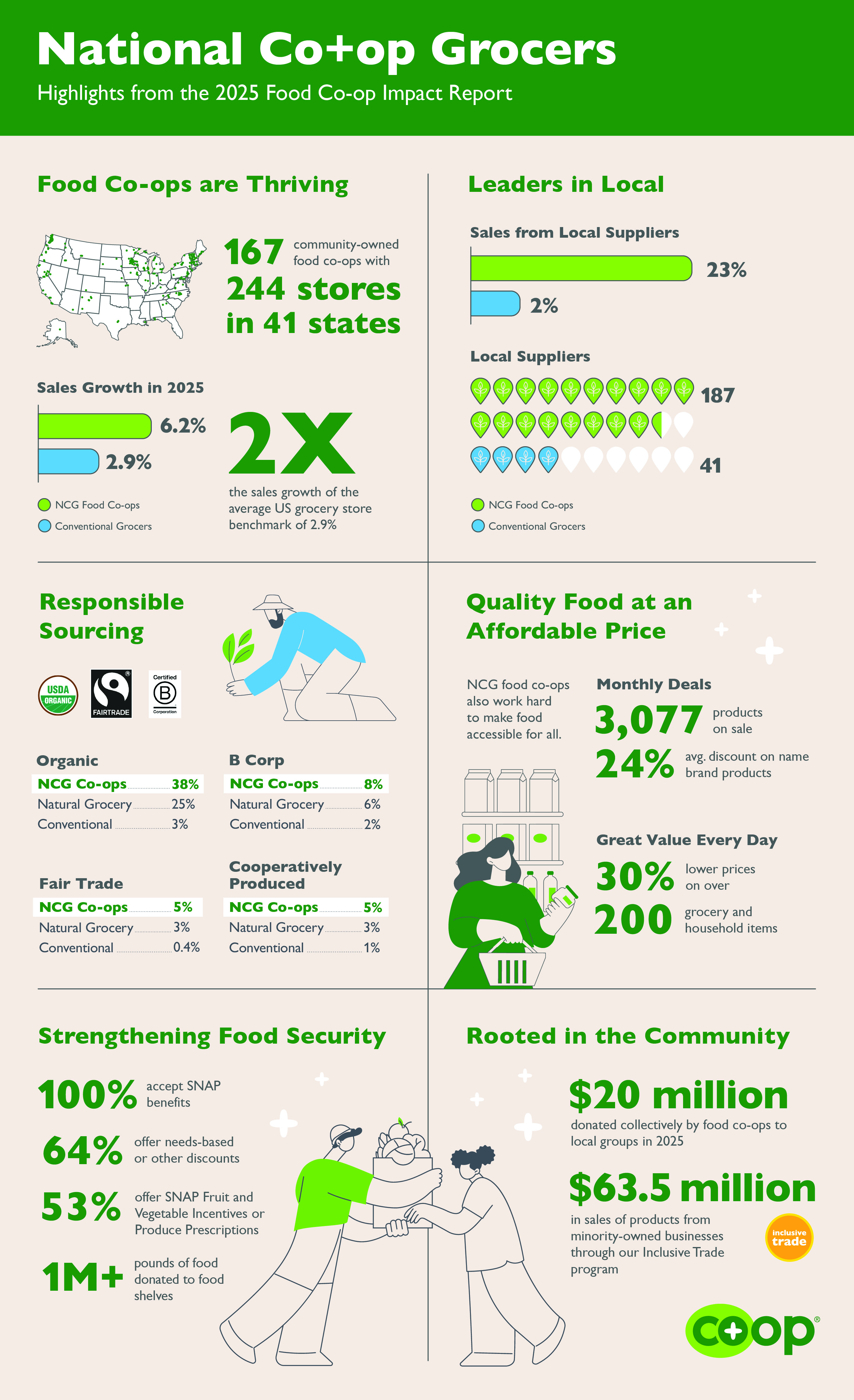
NCG food co-ops, who operate 244 stores, experienced sales growth of 6.2% in 2025, more than double the sales growth of the average US grocery store benchmark of 2.9%, according to data obtained from RetailStat.com.
Rooted in the Community
Contributing to this growth is the focus on supporting local farmers and producers. The average NCG food co-op purchases from 187 local suppliers, four and a half times as many as conventional grocers (41 farms on average). Twenty-three percent of the average food co-op’s sales come from local products, compared with just 2% of sales at conventional grocery stores.
Food co-ops local ownership means that stores are responsive to community needs, profits remain in the community and dollars go to support local economic development. Collectively, food co-ops donated more than $20 million to local groups last year, with an additional $500,000 donated to national organizations led by People of the Global Majority. Additionally, co-ops contributed $63.5 million in Inclusive Trade sales of products from minority-owned businesses.
Champions of Transparent Sourcing
Food co-ops continue to lead in organic product sales, with NCG reporting that 38% of food co-ops’ combined annual $2.8 billion sales come from Certified Organic products, compared with 25% of sales at other natural grocery retailers, and just 3% at conventional grocers (2025 SPINS data).
Products that are responsibly sourced also account for NCG co-ops’ sales growth with Fair Trade Certified products making up 5% of total sales, higher than other natural grocery retailers (3%) and conventional grocers (0.4%).
Sales of B Corp Certified products make up 8% of the average food co-op’s total sales, higher than other natural grocery retailers (6%) and conventional grocers’ (2%). B Corp Certification is a label that speaks to a company’s rigorous commitment to social and environmental sustainability. NCG has been a certified B Corp since 2011.
Food co-ops also support products that are cooperatively produced, such as dairy, chocolate and coffee farmer co-ops. Cooperatively produced products make up 5% of food co-ops’ total sales, higher than natural retailers (3%) and conventional grocers (1%).
Offering Quality Food at an Affordable Price
NCG food co-ops work hard to make food accessible for all:
- Co+op Deals: saves shoppers an average of 24% off regular prices on over 3,000 name brand products
- Co+op Basics: offers 30% lower prices on over 200 grocery and household items
- Membership discounts
NCG also leads federal advocacy work on behalf of member co-ops to strengthen food security, through funding nutrition assistance programs like SNAP, WIC and Produce Incentives. Of NCG member co-ops:
- 100% accept SNAP benefits
- 64% offer need-based or other discounts
- 53% offer SNAP Fruit and Vegetable Incentives or Produce Prescriptions
- 1M+ pounds of food donated to food pantries
The annual Impact Report analyzes the collective economic, social and environmental impacts and achievements of NCG’s community-owned member food co-ops. It is based on data collected from NCG food co-ops, SPINS natural products data, FMI Food Retailing Industry Speaks 2023 Report, and other data collected by National Co+op Grocers.
About National Co+op Grocers
National Co+op Grocers (NCG), founded in 1999, is a business services cooperative for retail food co-ops located throughout the United States. NCG helps unify food co-ops in order to optimize operational and marketing resources, strengthen purchasing power, and ultimately offer more value to natural food co-op owners and shoppers everywhere.
# # #
Media inquiries may be directed to meghan.flynn@ncg.coop